
- Up to 600%
- 15-min payouts
- Licensed
558H slots — reading RTP, volatility and bet size before you spin
Two slots can both advertise 96% RTP and empty a bankroll at completely different speeds. The number that decides which one you are playing is volatility, and it is almost never on the promotional banner. This guide shows what the information panel is telling you and how to size a bet so a session lasts.
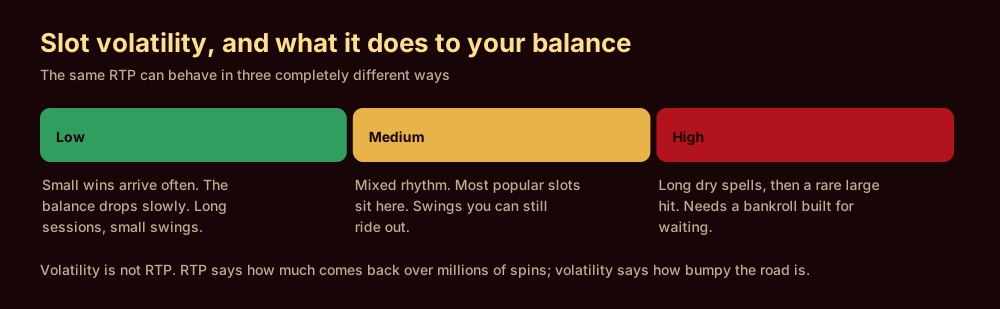
The information panel, and the four numbers on it
Every licensed slot carries an information panel, usually behind an "i" or a menu icon in the corner. Four numbers on it matter, and the rest is decoration.
| Number | What it means | What to do with it |
|---|---|---|
| RTP | Return to player, as a percentage of everything staked, averaged over millions of spins | Compare titles. A 96% slot returns ৳400 less per ৳10,000 staked than a 97% one, on average |
| Volatility | How the return arrives: often and small, or rarely and large | Match it to your bankroll, not to your mood |
| Maximum win | The cap, expressed as a multiple of your stake | Sanity check. A 50,000x cap is a marketing number, not a plan |
| Hit frequency | The share of spins that return anything at all, often around 20-30% | Expect most spins to return nothing. That is the design, not a fault |
Note what is not on that list: anything about a slot being "due", "hot", or "loose". Each spin is generated independently. A slot that has paid nothing for two hundred spins has exactly the same chance on spin two hundred and one as it had on spin one.
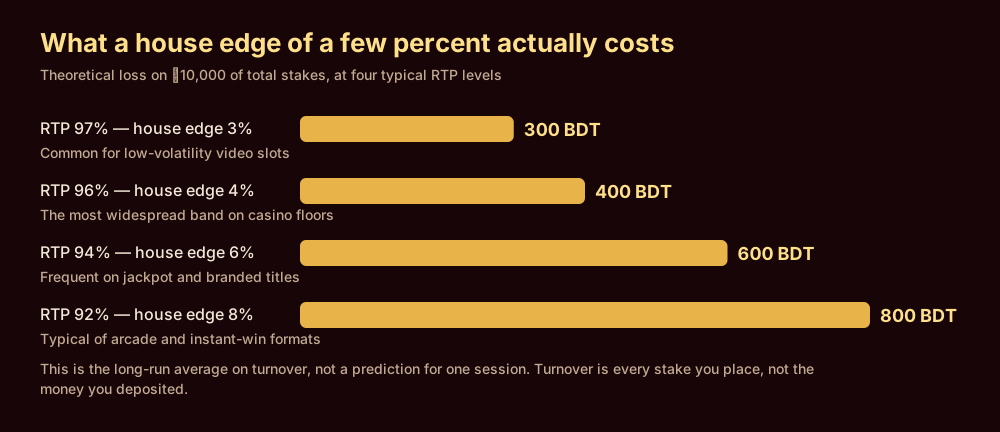
The RTP figures published for individual games at 558H: published slot RTP in this market runs roughly 94–97%, and the same game can ship at several RTP settings, so the figure in the game's own information panel is the one that applies to you — that is what this market typically offers, not a figure taken from 558H; confirm the exact terms on the operator's own page before you deposit
Three myths that cost money
“This slot is due for a win”
The gambler's fallacy, and the most expensive belief in the lobby. A random number generator holds no memory of the previous spin. Two hundred losing spins do not raise the odds of the next one by any amount.
“Bigger stakes unlock better returns”
RTP is a percentage, so a larger stake scales the win and the loss identically. What a bigger stake reliably changes is how fast your bankroll reaches zero.
“Autoplay and turbo are just convenience”
They are the single biggest multiplier on your real cost. At 900 spins an hour instead of 300, you pay the house edge three times as often for the same entertainment.
There is a fourth belief worth naming because it is subtler: that a near miss means something. Two matching symbols and a third landing just above the payline is designed to look like an almost-win. Mathematically it is a loss identical to any other, and it is engineered to feel different.
Sizing a bet to a bankroll in taka
Decide what the session is worth to you before you open the game, then divide. The table below is arithmetic, not advice about what to play.
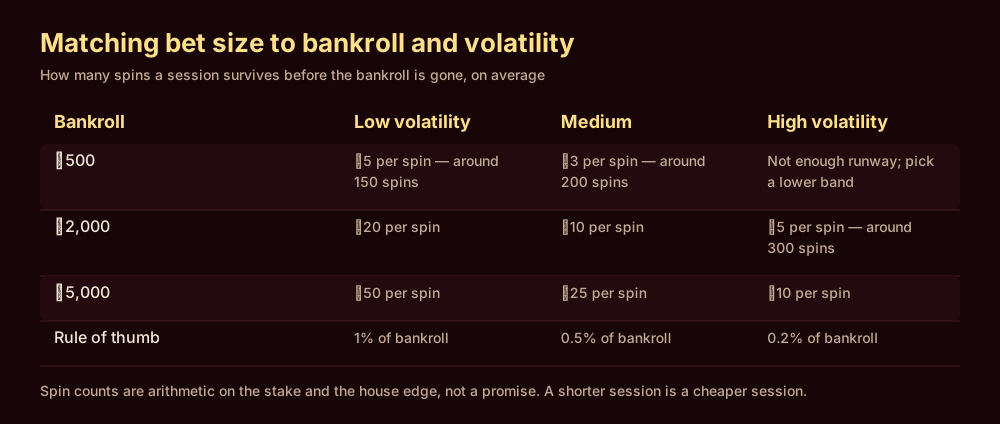
The practical version, in three lines:
- 1Set a deposit figure you are comfortable losing entirely, and treat it as the price of the evening rather than an investment.
- 2Divide it by 200 to get a starting stake. That gives you roughly two hundred spins before variance has the final word, which is enough to see the game rather than a snapshot of it.
- 3Turn off autoplay. It is the one setting that changes your hourly cost without changing anything you get in return.
Where the real cost hides: speed
The house edge is a percentage of turnover, and turnover is stakes multiplied by rounds. Most players think about the first number and ignore the second, which is why two people with the same bankroll and the same slot can lose at wildly different rates.
The arithmetic: at ৳10 a spin, 4% house edge and 300 spins an hour, the expected cost is ৳120 an hour. Push the same game to 900 spins an hour with autoplay and turbo, and it becomes ৳360 an hour. Nothing about the odds changed. You simply bought three hours of exposure in one.
If you take one thing from this page: the speed setting costs more than the slot choice. Slowing down is the only lever that reduces expected loss without reducing what you actually get out of the session.
Frequently asked questions
What is a good RTP for a slot?
Anything from 96% upwards is competitive; 94% and below is expensive. The figure is published in each game's information panel, and it is worth checking rather than assuming — the same title is sometimes supplied to operators at more than one RTP setting.
Does volatility change the RTP?
No. Two slots can share a 96% RTP and behave completely differently. Volatility describes how that 96% is delivered — steadily, or in rare bursts with long gaps.
Can a strategy beat a slot?
No. There is no bet pattern, timing or stake progression that changes the expected return of a random number generator. Strategies that claim otherwise are describing variance and calling it skill.
How many spins should a bankroll last?
As a working target, two hundred. Divide what you are willing to lose by 200 and that is your stake. It is a blunt rule, and it is far better than picking a stake because it felt round.
Are the slots at 558H fair?
Fairness depends on the game supplier's certification and the operator's licence, both of which you can check yourself rather than take on trust. The suppliers listed on the site and their testing certificates: verify on the operator's own game pages before playing.